Has your lawn not been looking its best and are you often left wondering what your lawn actually needs to help get it back on track? In this blog, we take a look at some of the common signs that your lawn is in distress, and how you can help get it on the mend.
Skip to: Why Does My Lawn Have Blue/Grey Patches? Why Has My Lawns Leaf Curled Up on Itself? Why Is My Grass Dying Off Quickly Over a Matter of Days? Why Does My Lawn Lose Its Colour After Mowing Why Does My Grass Look Pale/Yellow?
Why Does My Lawn Have Blue/Grey Patches?
During recent hot weather, has your lawn started developing brown patches with a blue/grey tinge like this?

When turf starts to show these blue/grey tinge patches, this is a common sign that your lawn is facing heat stress. So, what can you do to help get your lawn back on track?
First, it is best to give the patches a light rake through to pick up and remove the dry plant material. This will help create more space for the healthy grass to grow back over. Then, give your soil a good aerate to help decompact the soil profile. This will help better allow for air, water and nutrients to reach your lawns roots. Following this, we also recommend applying a soil wetter like Lawn Soaker to help the soil better absorb water down into the soil profile.
Over the following days and weeks, ensure you mow and water the lawn regularly to help it recover. When watering, ensure you water in the morning, before the heat of the day, for around 25 mins. Do this two to three times a week with a sprinkler that evenly covers the area.
Why Has My Lawns Leaf Curled Up on Itself?
Leaf blades that curl or fold in on themselves are a classic indicator that the lawn is not getting enough water. This response is common during prolonged hot and dry conditions as the plant tries to conserve water.
If your lawn is doing this, give it a good watering with a sprinkler that evenly covers your area. Water for around 25 mins, and water in the morning before the heat of the day.
Why Is My Grass Dying Off Quickly?
Has your grass has started to rapidly die off (over a few days) and damage is spreading? If so, this is a sign that your lawn may be facing an invasion of a pest called Armyworm. As the name suggests, Armyworm travel in large numbers, munching on your lawn.
Key identifying features of Armyworm include:
- Three prominent white or cream stripes down its body
- 2mm to 40mm in length
- Will curl up when disturbed
- Are most active at dawn or dusk
If you are unsure whether there are grubs in your lawn, there is a quick and easy way to test. Use a big bucket of water, add some dishwashing liquid so it is a soapy mix. Then pour this over the edge of the grass where it is declining and where the grass is still healthy. If there are grubs present, they will then rise up to the surface to breathe. This is best done at dawn or dusk when they are most likely to be active.
If you do find Armyworms in your lawn, it is best to act quickly to help prevent any further damage from occurring. Please check out our blog here for more information on Armyworm treatment and prevention options.
Why Does My Lawn Lose Its Colour After Mowing?
If your lawn suddenly loses its colour after mowing, this is a sign that you are removing too much of the leaf. This process is known as scalping. Scalping your lawn can occur for two different reasons. The first, if your lawn is not mown regularly enough. The second is if your lawns levels are uneven.
When mowing, it is best to ensure you are mowing your lawn regularly enough so that only one third of the leaf is removed with each pass.
For more information on how you can help avoid scalping from occurring to your lawn, check out our blog here.
Why Does My Grass Look Pale/Yellow?
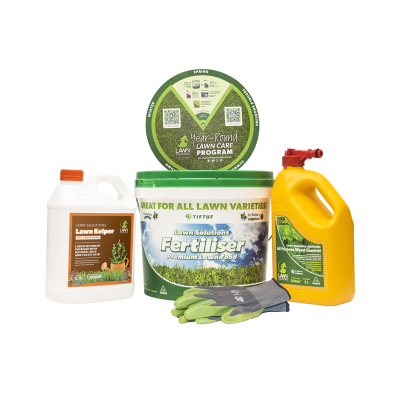
Is your lawn not looking as vibrant as it once was or is looking pale or yellow? This may be a sign that your lawn is lacking in nutrients. The best way to help replenish these nutrients is to apply a well-rounded fertiliser like the Lawn Solutions Premium Fertiliser.
The Lawn Solutions Premium Fertiliser has a balanced ratio of Nitrogen, Potassium, Phosphorus, Iron and other important trace elements. This fertiliser also contains a fast and slow release granule. This gives your lawn a good up front boost in nutrients, as well as a sustained boost over a 12 week period.
For more lawn care tips and advice, make sure you check out our other lawn care blogs here.