Wetting agents and soil amendments are commonly used terms when it comes to lawn care. In this blog we will look at exactly what wetting agents and soil amendments are, and how they can help ensure you have a healthy lawn.
Skip to: Wetting agents, Different types of wetting agents, When do I apply a wetting agent? Lawn Soaker wetting agent, Soil amendments, Soil conditioners, Compacted soils, Soil pH, Clay soils
Wetting Agents
A wetting agent is like a detergent or surfactant that attracts water to the soil’s surface. Applying a wetting agent will help the water soak into the soil, making the water available to your lawn’s roots. It will help increase the soil’s ability to hold nutrients and help increase the drought tolerance of your lawn so it can sand up to the hot summer days.
Different types of wetting agents
Soil wetting agents are available as granules, liquid concentrates, and hose on bottles.
Most granular and liquid concentrates need to be watered in well, but it is always best to check the product label.
When do I need to apply a wetting agent?
If your lawn is suffering from dry patches or is hydrophobic a wetting may be needed.
Hydrophobic lawns will pool water at the soil’s surface and will struggle to let the moisture soak down into the soil base. Dry patches or heat stressed turf can present in patches rather than across the whole lawn.
Wetting agents are best applied when the temperatures are cooler, either in the morning or afternoon. Repeated applications can be made every few months on an as needed basis.

Product recommendation
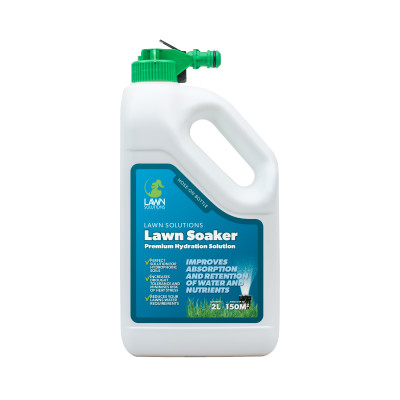
We recommend using our Lawn Solutions Lawn Soaker. Lawn Soaker comes in a 2L clip-on ready-to-use hose-on bottle, treating up to 150m2 as well as a 2.5L concentrate that is applied through a knapsack or pressure sprayer.
Soil Amendments
By having the correct soil base your lawn roots will be able to grow and thrive. If you have a good soil base where water can flow through the profile, is free from compaction, and has a good amount of nutrients your grass has a higher chance of being healthier. Soil amendments are best made before laying your lawn down, however they still can be corrected after a lawn is laid.
Soil Conditioner
Soil conditioners can help improve the health of the soil, and as a result will help your lawn too. By using a soil conditioner, you will help stimulate new root and shoot growth, improve turf vigour and strength and strengthen the turf’s resilience against disease and pest activity. If you are looking to use a soil conditioner on your lawn, our go-to is Lawn Kelper, available in both hose-on and concentrate.
Compacted soil
Soil compaction can occur as a result from high foot traffic in an area, from kids or pets, or in other frequently used areas. Heavier clay soils are very tight and bind together making compaction a common problem.
When compaction occurs, it can hinder the lawns’ ability to grow deeper into the soil. It can limit the amount of nutrients and water that can reach the root of your lawn.
To help alleviate compaction aerate with a garden fork, aerating sandals or a tyne aerator. For more information on aerating your lawn click here.
Soil pH
Ideally, a soils pH should be somewhere between 5.5 and 7. An acidic soil will be below 5.5 and an alkaline soil will be over 8. To test your soil, use a soil pH testing kit. We have an easy-to-use soil pH testing kit available here. Soil pH kits are also readily available from nurseries and garden centres.
If your soil is outside a pH of 5.5 and 7 you may need to look at making adjustments. If this is the case, check out our blog for more information here.
Clay soil
A clay base can make it difficult for the roots of your lawn to grow down into the soil profile. Clay soils will often struggle to drain water away, especially if it is compacted.
To help improve a soil with a clay base, you can apply a clay breaker like gypsum. Please have a look at our blog for more information here.
Making amendments before laying a lawn
If you are looking to lay a new lawn it is best to make any soil amendments before installation. In most cases, if you are bringing new soil in amendments shouldn’t need to be made.
For more lawn care tips and advice, you can check out our other lawn care blogs here.