If your lawn is looking a little worse for wear after weeks or even months without care, you’re in the right place. Whether it has been invaded by weeds, has become overgrown, or just needs some general TLC, here’s our five step guide on how to get your lawn back into shape.
Skip to:
- What Is The Best Way To Mow An Overgrown Lawn?
- How Often Do I Need to Water My Lawn After a Big Cut?
- How Do I Remove Weeds In An Overgrown Lawn?
- When Should I Apply Fertiliser to My Repairing Lawn?
- Why Is Regular Maintenance Essential For a Healthy Lawn?
Step 1 – What is the Best Way to Mow an Overgrown Lawn?
Your first step to taming an overgrown lawn is reducing its height, although the exact approach will depend on just how tall it has grown.
If you can still push your mower through the grass on its highest setting, start there. On your next pass, drop the mowing height by a notch or two. Repeat this gradual process until you mow a notch or two lower than your preferred height.
Mowing slightly lower than your target length allows the new leaf to grow back in at a lower height. This means that next time you mow, you’ll only be removing the top of the new leaf rather than cutting back into the stem and scalping the lawn. Just make sure you use your catcher to collect the clippings!
If your lawn has grown too high for a mower, a different approach will be needed. Start by using a whipper snipper or line trimmer to cut back the excess growth, then rake up the clippings. Once that’s done, you should be able to get your mower out and follow the steps above.

Tips for taming an overgrown lawn:
- Ensure the lawn is dry first. This will help make it easier to trim and remove the excess growth.
- Catch and remove the grass clippings. This will stop smothering the vulnerable grass, so that it will be able to grow back and repair.
Step 2 – How Often Do I Need to Water My Lawn After a Big Cut?
Once your lawn’s height is under control, the grass will be vulnerable to the elements. If the weather is warm or hot while the lawn repairs, be extra cautious and make sure you are watering it more frequently than usual. As the lawn repairs and gets back into its normal shape, you can then look at cutting this back.
Step 3 – How Do I Remove Weeds in an Overgrown Lawn?
If weeds were growing before your lawn’s big mow, they are likely to start growing back over the coming weeks.
If only a small amount of weeds grow through, the best and easiest approach is to pull them out by hand. However, if you are dealing with a few too many broadleaf weeds for hand-pulling, your best option is to apply a broadleaf herbicide such as All Purpose Weed Control or Estate Herbicide.
If other weed types appear and you’re not sure which product to use, check out our Ultimate Weed Guide Blog or feel free to reach out to us directly.
Step 4 – When Should I Apply Fertiliser to my Repairing Lawn?
Once the grass has started to green up and new growth has returned, you can look at applying a fertiliser to give it a boost. Although it might be tempting to fertilise straight after your big mow, it is best to hold off for a few weeks to avoid causing extra stress to the grass.
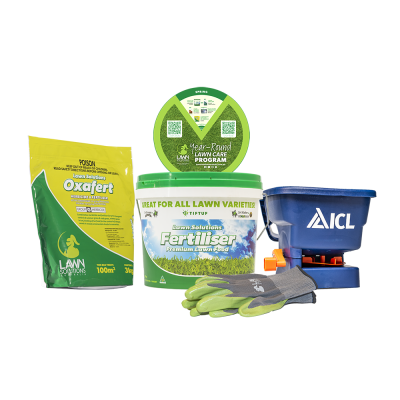
We recommend applying a well-rounded lawn food, something like our Lawn Solutions Premium Fertiliser. This fertiliser features a combination of fast and slow-release granules. This will give your lawn an immediate upfront boost while continuing to feed it for around 12 weeks.
Step 5 – Why is Regular Maintenance Essential for a Healthy Lawn?
While your lawn is recovering, the best thing that you can do for your lawn is to keep up with your regular lawn maintenance. We recommend implementing a simple lawn care regime of regular mowing, watering on an as needed basis, and removing weeds as they appear.
By following this, your lawn’s stress levels will be vastly reduced, and you will give it the best chance to thicken up, grow more consistently and prevent it from becoming overgrown again.
For more lawn care tips and advice, make sure you check out our other lawn care blogs here.